Several weeks ago, I gave a presentation at an event for Minas International, a network of English-speaking foreigners and native Brazilians here in Belo Horizonte that organizes various business, social, and volunteer events. (More info on Minas International - www.minasinternational.com)
Attached is a link to my presentation. I left most of my talking points brief and then filled them in during the actual presentation, so it's hard to get a full sense of what I discussed, but this nevertheless provides an outline of the key points I tried to raise during the talk.
For any Portuguese speakers, if you look on the right side of the website under "Related", you will be able to see various other presentations from people involved in the MNCR - technical advisors, catadores, government representatives, etc. There are also some international presentations, including some in English, in case anyone wants to check those out. Enjoy!
http://www.slideshare.net/MinasInternational/trash-talk-by-patrick-mcananey-2-august-2011

Reflections on recycling cooperatives in Brazil
Friday, August 19, 2011

Capacity Building in the Cooperatives
As I mentioned in my last post, one of the greatest challenges we are dealing with in our work is the process of building capacity within the cooperatives while respecting their existing structures and work methods. Last week, during a visit to Coopert, a cooperative in Itauna, MG that is part of the Cataunidos network, I had to deal with a very simple example of this difficulty.
Currently, we are trying to systematize information gathering across the Cataunidos organizations as part of our goal of standardizing and improving financial management of the cooperatives. At Coopert, we are working with the treasurer to develop systems to measure employee wages and benefits, fixed and variable expenses, and quantity/price of commercialized materials. I helped put together some spreadsheets for the treasurer to use in order to track this data, based off of information the cooperative already collects. However, as we were going over the forms, it became pretty apparent that we were going to have some issues.
Right now, hours of the Coopert associates are added up manually. But instead of using a regular decimal system, the treasurer adds the numbers up so that decimals represent minutes. That is, 18.2 means "18 hours and 20 minutes" even though that is not an equivalent value. So when adding all the hours together and then multiplying it by the hourly wage (dependent on total income earned in the cooperative divided by total numbers of hours worked by all associates), the end result is an inaccurate number. When I tried to explain to the treasurer that she had to convert the hours/minutes numbers into decimal numbers, she quickly became confused. Although I tried for a while to explain the idea (with help from Guilherme, one of the INSEA technicians), it became apparent that she was becoming discouraged and preferred to just keep using the system that they already had in place. Then, an ex-treasurer of Coopert came in to the office and told us that he thought messing around on computers was too complicated and was bound to mess up their administrative process.
The whole experience was quite revealing to me in terms of the practical limits we are dealing with in this movement. The catadores in general lack very basic education, meaning that something as simple as the difference between decimal numbers and hour/minute numbers can be a huge problem for them. This anecdote reveals just how far off we are from having the cooperatives really take control of their financial management, create strategic business plans, and commercialize effectively through the Cataunidos network in order to become commercially viable businesses. The idea of using computers, even for something as simple as spreadsheets, clearly is not going to work, at least in the short term. As soon as something goes wrong (having to add another column, or an Excel formula error), the entire process would become messed up as they would not have the detailed knowledge to fix the issue. The problem is that you cannot build a strong cooperative administrative structure without an educational base to begin with.
And yet building that educational base is a challenge. If we were to show up one day at the cooperative and try to convince everyone to take a math class, they would no doubt yell at us and say the activity was worthless - when a catador needs to collect, sort, and process his materials, what good is learning some abstract theoretical concept like math that has nothing to do with his daily life? Incentivizing the community to build the educational base is extremely difficult.
Yet if we take the other approach and focus simply on skills training for the select few in the directorship, other problems arise. First off, leadership positions are supposed to rotate, and the most successful cooperative leaders sometimes end up leaving the group to pursue new opportunities anyway (the traditional head of the Nova Lima association, for example, is now running for city council). So the strategy can backfire due to the simple issue of turnover. But also, it is hard for the leadership of the cooperatives to stake out unpopular positions among the group, due both to simple peer pressure and presumed respect for democratic decision-making. So if we focuses our training on a few individuals without building consensus, this often fails anyway as the leaders are unable to win support for new administrative procedures. It really creates a tough situation from either direction.
One thing that caught my eye was the history of Rede-sol, a separate network of catadores in the BH metro area that is not affiliated with Cataunidos. The Rede-sol cooperatives are in fact much more effective at financial management than the Cataunidos groups, which at first gave me hope that we had discovered a successful model that could be replicated. However, when I dug deeper I found that this was not the case. Rede-sol is successful in its financial management precisely because it has the sort of traditional hierarchy that the Cataunidos groups try to avoid - the leaders in the diretoria tend to have a very different profile from the rest of the workers, coming from more skilled labor and educated backgrounds. They end up taking control of the cooperatives and centralizing decision-making. While this brings clear benefits in terms of management efficiency, the fear of creating a two-tiered system within the groups certainly gives me pause.
At times, I get frustrated dealing with these issues because there really seem to be no good answers. Is there a way to build and strengthen these cooperatives and associations without sacrificing the social cohesion, inclusion and equality that they have worked so diligently over time to cultivate? At this point, I really just don't know.
Some pictures of Coopert:


Currently, we are trying to systematize information gathering across the Cataunidos organizations as part of our goal of standardizing and improving financial management of the cooperatives. At Coopert, we are working with the treasurer to develop systems to measure employee wages and benefits, fixed and variable expenses, and quantity/price of commercialized materials. I helped put together some spreadsheets for the treasurer to use in order to track this data, based off of information the cooperative already collects. However, as we were going over the forms, it became pretty apparent that we were going to have some issues.
Right now, hours of the Coopert associates are added up manually. But instead of using a regular decimal system, the treasurer adds the numbers up so that decimals represent minutes. That is, 18.2 means "18 hours and 20 minutes" even though that is not an equivalent value. So when adding all the hours together and then multiplying it by the hourly wage (dependent on total income earned in the cooperative divided by total numbers of hours worked by all associates), the end result is an inaccurate number. When I tried to explain to the treasurer that she had to convert the hours/minutes numbers into decimal numbers, she quickly became confused. Although I tried for a while to explain the idea (with help from Guilherme, one of the INSEA technicians), it became apparent that she was becoming discouraged and preferred to just keep using the system that they already had in place. Then, an ex-treasurer of Coopert came in to the office and told us that he thought messing around on computers was too complicated and was bound to mess up their administrative process.
The whole experience was quite revealing to me in terms of the practical limits we are dealing with in this movement. The catadores in general lack very basic education, meaning that something as simple as the difference between decimal numbers and hour/minute numbers can be a huge problem for them. This anecdote reveals just how far off we are from having the cooperatives really take control of their financial management, create strategic business plans, and commercialize effectively through the Cataunidos network in order to become commercially viable businesses. The idea of using computers, even for something as simple as spreadsheets, clearly is not going to work, at least in the short term. As soon as something goes wrong (having to add another column, or an Excel formula error), the entire process would become messed up as they would not have the detailed knowledge to fix the issue. The problem is that you cannot build a strong cooperative administrative structure without an educational base to begin with.
And yet building that educational base is a challenge. If we were to show up one day at the cooperative and try to convince everyone to take a math class, they would no doubt yell at us and say the activity was worthless - when a catador needs to collect, sort, and process his materials, what good is learning some abstract theoretical concept like math that has nothing to do with his daily life? Incentivizing the community to build the educational base is extremely difficult.
Yet if we take the other approach and focus simply on skills training for the select few in the directorship, other problems arise. First off, leadership positions are supposed to rotate, and the most successful cooperative leaders sometimes end up leaving the group to pursue new opportunities anyway (the traditional head of the Nova Lima association, for example, is now running for city council). So the strategy can backfire due to the simple issue of turnover. But also, it is hard for the leadership of the cooperatives to stake out unpopular positions among the group, due both to simple peer pressure and presumed respect for democratic decision-making. So if we focuses our training on a few individuals without building consensus, this often fails anyway as the leaders are unable to win support for new administrative procedures. It really creates a tough situation from either direction.
One thing that caught my eye was the history of Rede-sol, a separate network of catadores in the BH metro area that is not affiliated with Cataunidos. The Rede-sol cooperatives are in fact much more effective at financial management than the Cataunidos groups, which at first gave me hope that we had discovered a successful model that could be replicated. However, when I dug deeper I found that this was not the case. Rede-sol is successful in its financial management precisely because it has the sort of traditional hierarchy that the Cataunidos groups try to avoid - the leaders in the diretoria tend to have a very different profile from the rest of the workers, coming from more skilled labor and educated backgrounds. They end up taking control of the cooperatives and centralizing decision-making. While this brings clear benefits in terms of management efficiency, the fear of creating a two-tiered system within the groups certainly gives me pause.
At times, I get frustrated dealing with these issues because there really seem to be no good answers. Is there a way to build and strengthen these cooperatives and associations without sacrificing the social cohesion, inclusion and equality that they have worked so diligently over time to cultivate? At this point, I really just don't know.
Some pictures of Coopert:

Coopert truck - materials are unloaded at the entrance to the cooperative

Entrance to the silo - materials are pushed down the chute to be sorted

Side view of the silo - materials fall down chute and then onto a conveyor belt for sorting. Once sorted, the materials fall down various chutes into bags below the conveyor belt.

At the end of the conveyor belt, rejected material is discarded into an open area, where it is eventually removed to the landfill next to the cooperative.
Tuesday, August 2, 2011
Reflections on the Cooperative Model
While many aspects of the recycler movement have fascinated me so far in my research, there is one area that has really caught my attention: internal management structures of the cooperatives. My original grant proposal was to focus on that specific topic, so it is no surprise that I keep coming back to it. The cooperative model presents fascinating philosophical and economic questions and I constantly find myself reflecting on its broader implications. At times, these reflections leave me excited and optimistic. But at other times, I find myself becoming increasingly skeptical of the future of this movement.
Positive Aspects
There is a lot to be said for the benefits of the cooperative structure within the context of the recycler movement. The fact that these organizations are completely organized and managed by the catadores themselves is a wonderful testament to the abilities of these individuals. These businesses are run by the workers themselves through a process that emphasizes teamwork and equality, using democratic decision-making processes and rotating leadership responsibilities to maintain a positive dynamic and buy-in from each associate. This stands in sharp contrast to traditional capitalist means of production, which emphasize hierarchical business structures and promote competition as a way to increase incentives. The goal is a more humane production process, one that does not merely treat the worker as another form of input/capital but rather as an individual human being, whose agency and feelings must be taken into account. The trade-off between these two processes is relatively clear: efficiency and maximization of production vs. valorization of the worker and humanization of the production process.
For most catadores, the cooperative structure is not only beneficial because it gives them more agency within their work environment. Simply put, it is the only structure in which many of them are able to make a living. Many catadores live on the margins of society, unable to participate fully in our traditional capitalist system because they are not efficient enough producers to sell their abilities on the labor market. The reasons for this vary: physical or mental disabilities, old age, lack of education, drug/alcohol addiction issues, health problems, etc. Many simply cannot compete and survive within traditional workplace settings, which is why they have been relegated to the streets or the trash dumps. Within the cooperatives, however, the catadores take care of each other. They recognize that there are some who are unable to collect or sort as much material, but they still allow those people to participate in the group and receive a decent share for their efforts. As one catador said to me recently, "our goal isn't just to produce as much as possible, it's to make sure we give everyone a chance to be included and participate."
Drawbacks
Of course, this sort of model has very clear downsides. As pretty much everyone who has ever studied communist economies knows, emphasis on inclusion and equality rather than incentives and efficiency undermines economic dynamism and growth. These cooperatives are certainly not an exception. A common slang term within the organizations is people who are morcegando ("batting"), sitting around and not working hard while letting others pick up the slack. Because remuneration schemes within the cooperatives are not fully based on individual production (some groups divide revenues equally, some by work hours, some by a system of quotas), it can be difficult motivating people to work to the full of their abilities. Some cooperatives use extremely subjective measures of how much someone was perceived to be morcegando in order to dock their pay. It often falls to the associates holding rotating leadership positions within the diretoria to supervise the production process and hold everyone to account, but these people are often busy with administrative duties and do not have time to resolve every problem or conflict. One idea often discussed is to create official supervision posts within the cooperatives, but the creation of such hierarchical structures creates a whole new set of conflicts within the group and undermines the goals of equality and inclusion. This is just one example of the constant trade-off within these organizations between the social goals of the cooperative and the production goals of the business enterprise.
The bigger issue for me, however, has to do more with the leadership of these organizations. Overall, I strongly admire the goal of having the catadores themselves completely run and manage these organizations. This is, after all, their movement. They are the ones who have made livings for themselves collecting recycling and who have made these organizations possible. To believe in the cooperative model, you have to believe in the power of the workers to organize and lead themselves and to manage their own systems of production. For us technicians and outsiders to come in and try and take over these groups not only undermines the agency and empowerment of the catadores, it also reinforces the idea that enterprises must be run by the elite and well-educated.
But at the end of the day, I worry that sticking rigidly to these beliefs undermines the expansion and development of these enterprises. There are many complex aspects of integrated solid waste management and recycling programs in developing urban communities, and for this sector to be able to grow and thrive using a profitable triple-bottom line the companies that pioneer it really need to be dynamic, innovative and capable. While I do not doubt that there are many impressive catador leaders out there (several of whom I already know), most of the individuals within the movement do not have the formal education, business administration skills or technical expertise to fully handle these responsibilities themselves. The strengths of the MNCR tend to lie in the catadores' keen understanding of social issues: organizing workers, social mobilization and political lobbying. In terms of the more business-minded ability to handle complex financial accounting, develop strategic action plans for expansion and improve commercial viability, the organizations seem to be severely lacking. While there are certain individuals with strong leadership abilities who I believe we could single out for intense training and skill development, this risks creating two tiers of catadores within the organizations, which creates its own set of problems. (In practice this inequality between catadores often exists already, but the theory of rotating leadership positions is meant to correct the issue.)
While I do not support the idea of non-catadores taking over the management of the organizations because it would completely undermine the goals and philosophy of the cooperative model, I often worry if this movement will have a very low ceiling unless we change our approach. I just do not see how the catadores themselves will be able to develop large-scale commercially viable social enterprises that can fully handle integrated waste management services and process recyclables with the limited role that outside technicians and business partners currently play.
Basically, everything always seems to come down to this question for me. To what extent should we be sitting back and letting the catadores themselves fully control this movement, and to what extent should we be taking the lead to help build and expand the cooperatives? Is there really a "correct" balance that can be found? And if one thing or another must be sacrificed at times, is it better to sacrifice the ownership of the catadores and the cooperative model to further develop these enterprises, or is it better to pass up opportunities for growth and improvement (and better environmental management) in order to ensure the primacy of the catadores and their cooperative leadership approach?
Positive Aspects
There is a lot to be said for the benefits of the cooperative structure within the context of the recycler movement. The fact that these organizations are completely organized and managed by the catadores themselves is a wonderful testament to the abilities of these individuals. These businesses are run by the workers themselves through a process that emphasizes teamwork and equality, using democratic decision-making processes and rotating leadership responsibilities to maintain a positive dynamic and buy-in from each associate. This stands in sharp contrast to traditional capitalist means of production, which emphasize hierarchical business structures and promote competition as a way to increase incentives. The goal is a more humane production process, one that does not merely treat the worker as another form of input/capital but rather as an individual human being, whose agency and feelings must be taken into account. The trade-off between these two processes is relatively clear: efficiency and maximization of production vs. valorization of the worker and humanization of the production process.
For most catadores, the cooperative structure is not only beneficial because it gives them more agency within their work environment. Simply put, it is the only structure in which many of them are able to make a living. Many catadores live on the margins of society, unable to participate fully in our traditional capitalist system because they are not efficient enough producers to sell their abilities on the labor market. The reasons for this vary: physical or mental disabilities, old age, lack of education, drug/alcohol addiction issues, health problems, etc. Many simply cannot compete and survive within traditional workplace settings, which is why they have been relegated to the streets or the trash dumps. Within the cooperatives, however, the catadores take care of each other. They recognize that there are some who are unable to collect or sort as much material, but they still allow those people to participate in the group and receive a decent share for their efforts. As one catador said to me recently, "our goal isn't just to produce as much as possible, it's to make sure we give everyone a chance to be included and participate."
Drawbacks
Of course, this sort of model has very clear downsides. As pretty much everyone who has ever studied communist economies knows, emphasis on inclusion and equality rather than incentives and efficiency undermines economic dynamism and growth. These cooperatives are certainly not an exception. A common slang term within the organizations is people who are morcegando ("batting"), sitting around and not working hard while letting others pick up the slack. Because remuneration schemes within the cooperatives are not fully based on individual production (some groups divide revenues equally, some by work hours, some by a system of quotas), it can be difficult motivating people to work to the full of their abilities. Some cooperatives use extremely subjective measures of how much someone was perceived to be morcegando in order to dock their pay. It often falls to the associates holding rotating leadership positions within the diretoria to supervise the production process and hold everyone to account, but these people are often busy with administrative duties and do not have time to resolve every problem or conflict. One idea often discussed is to create official supervision posts within the cooperatives, but the creation of such hierarchical structures creates a whole new set of conflicts within the group and undermines the goals of equality and inclusion. This is just one example of the constant trade-off within these organizations between the social goals of the cooperative and the production goals of the business enterprise.
The bigger issue for me, however, has to do more with the leadership of these organizations. Overall, I strongly admire the goal of having the catadores themselves completely run and manage these organizations. This is, after all, their movement. They are the ones who have made livings for themselves collecting recycling and who have made these organizations possible. To believe in the cooperative model, you have to believe in the power of the workers to organize and lead themselves and to manage their own systems of production. For us technicians and outsiders to come in and try and take over these groups not only undermines the agency and empowerment of the catadores, it also reinforces the idea that enterprises must be run by the elite and well-educated.
But at the end of the day, I worry that sticking rigidly to these beliefs undermines the expansion and development of these enterprises. There are many complex aspects of integrated solid waste management and recycling programs in developing urban communities, and for this sector to be able to grow and thrive using a profitable triple-bottom line the companies that pioneer it really need to be dynamic, innovative and capable. While I do not doubt that there are many impressive catador leaders out there (several of whom I already know), most of the individuals within the movement do not have the formal education, business administration skills or technical expertise to fully handle these responsibilities themselves. The strengths of the MNCR tend to lie in the catadores' keen understanding of social issues: organizing workers, social mobilization and political lobbying. In terms of the more business-minded ability to handle complex financial accounting, develop strategic action plans for expansion and improve commercial viability, the organizations seem to be severely lacking. While there are certain individuals with strong leadership abilities who I believe we could single out for intense training and skill development, this risks creating two tiers of catadores within the organizations, which creates its own set of problems. (In practice this inequality between catadores often exists already, but the theory of rotating leadership positions is meant to correct the issue.)
While I do not support the idea of non-catadores taking over the management of the organizations because it would completely undermine the goals and philosophy of the cooperative model, I often worry if this movement will have a very low ceiling unless we change our approach. I just do not see how the catadores themselves will be able to develop large-scale commercially viable social enterprises that can fully handle integrated waste management services and process recyclables with the limited role that outside technicians and business partners currently play.
Basically, everything always seems to come down to this question for me. To what extent should we be sitting back and letting the catadores themselves fully control this movement, and to what extent should we be taking the lead to help build and expand the cooperatives? Is there really a "correct" balance that can be found? And if one thing or another must be sacrificed at times, is it better to sacrifice the ownership of the catadores and the cooperative model to further develop these enterprises, or is it better to pass up opportunities for growth and improvement (and better environmental management) in order to ensure the primacy of the catadores and their cooperative leadership approach?
Monday, August 1, 2011
CATAUNIDOS and the Future of Commercialization Networks
So most of my work here so far has been through the CATAUNIDOS network. As I mentioned in an earlier post, CATAUNIDOS is a commercialization network of nine associations and cooperatives in the BH metro area. Officially registered as a cooperative itself, the purpose of CATAUNIDOS is to pool materials collected by the nine organizations in order to sell as a single unit. There are two main benefits to this approach. First, selling on a larger scale means that the catadores have more influence in the market, circumventing small-scale middlemen and selling higher up in the supply chain to receive a better deal for their goods. Second, pooling materials together creates opportunities to add value to the materials. Normally, most organizations of catadores simply collect, sort, press and sell recyclables. But this is only the first step in the recycling industry. By further processing materials into more finished products, catadores add more value to recyclables and greatly increase their role within the market. CATAUNIDOS has pioneered this approach by opening a plastic processing factory in BH. The nine organizations send the PET plastic they collect to the warehouse, where it is further sorted into various types (I still don't fully understand the categories but the level of sorting within the warehouse is extremely specific). The plastic is then processed through machinery that grinds it, washes it, and molds it into small pellets, the basic raw material used in plastic manufacturing. The CATAUNIDOS factory is the only fully catador-operated factory in all of Latin America.
Currently, the industrial unit is closed for remodeling. A new action plan and business model is currently under development with the help of various technical advisors and consultants, including representatives from SEBRAE (Brazilian Support Service for Small Enterprises), UFMG and SERVAS (a social welfare support program). While I am just starting to get involved with this project and do not have intimate knowledge of the details, I do know that one of the principal goals of this remodeling is to find new machinery that will allow CATAUNIDOS to further process its plastics and sell a more refined final product. One idea that has been discussed is plastic roofing, which is extremely durable and more cost-effective than traditional wood roofs. If the factory were able to develop actual consumer goods like this, it would be a significant step forward for the movement of catadores as it would mean no longer selling only raw materials for input to industry but rather creation of actual products for marketing. However, as far as I am aware this remains a long-term goal and not one that is possible any time in the near future.
With the team from INSEA, I am part of a project sponsored by Petrobras (the Brazilian public-private oil company) to strengthen and expand the CATAUNIDOS network. We are trying to improve the functioning of the nine organizations that currently make up the network, add an additional 16 organizations, and create a more efficient business model through the standardization of practices across the groups and improving the functionality of the factory.
One thing thing that I have found striking so far in my work with CATAUNIDOS has been how nebulous the concept of the "commercialization network" is. In our day to day activities, I have noticed that it is never very clear who actually represents CATAUNIDOS, and the catadores themselves do not feel like members of the cooperative. Madalena and Gilberto, two catadores who jointly run the network, are the two clear leaders of the group. But aside from that, the catadores within the associations and cooperatives do not seem to identify with CATAUNIDOS. They view us, the INSEA technicians, as the members of CATAUNIDOS, when really in fact we are supposed to be merely advisers. Especially right now with the factory closed and all sale of products happening within the individual organizations, the only visible aspect of CATAUNIDOS are the technical visits from INSEA and the training workshops we sponsor for the catadores (more on those workshops in a later post). As one of my co-workers recently put it, "many of these catadores barely feel a connection to their individual organization, let alone the more general network of CATAUNIDOS." This quote sums up one of our principal challenges going forward. How do we get the catadores to take greater ownership of this network going forward, and what should our role be in the process?
The future of cooperatives and associations of catadores will depend significantly on the future of these commercialization networks. By themselves, the organizations do not have the scale, capital or technical expertise to become dynamic, commercially-viable enterprises. Networks can potentially help to overcome these weaknesses, especially by building processing centers for materials such as plastics, e-waste, or even organic materials for composting or biogas. INSEA is focusing now on this concept of networks, or "redes," throughout the state of Minas - there are currently five such projects in the works. Ultimately, though, I think it will be up to CATAUNIDOS to set the example across the state, and even the country. (However, there is one other large-scale network project in Brazil, the CATASAMPA group in São Paulo.) The lessons we learn from the Petrobras project will be key in helping to understand the challenges and opportunities of this movement going forward.
We are currently working both on revamping the INSEA website and creating a CATAUNIDOS site as well. I will be providing English translations. As soon as those are both up I will post the addresses here for everyone to check out!

Currently, the industrial unit is closed for remodeling. A new action plan and business model is currently under development with the help of various technical advisors and consultants, including representatives from SEBRAE (Brazilian Support Service for Small Enterprises), UFMG and SERVAS (a social welfare support program). While I am just starting to get involved with this project and do not have intimate knowledge of the details, I do know that one of the principal goals of this remodeling is to find new machinery that will allow CATAUNIDOS to further process its plastics and sell a more refined final product. One idea that has been discussed is plastic roofing, which is extremely durable and more cost-effective than traditional wood roofs. If the factory were able to develop actual consumer goods like this, it would be a significant step forward for the movement of catadores as it would mean no longer selling only raw materials for input to industry but rather creation of actual products for marketing. However, as far as I am aware this remains a long-term goal and not one that is possible any time in the near future.
With the team from INSEA, I am part of a project sponsored by Petrobras (the Brazilian public-private oil company) to strengthen and expand the CATAUNIDOS network. We are trying to improve the functioning of the nine organizations that currently make up the network, add an additional 16 organizations, and create a more efficient business model through the standardization of practices across the groups and improving the functionality of the factory.
One thing thing that I have found striking so far in my work with CATAUNIDOS has been how nebulous the concept of the "commercialization network" is. In our day to day activities, I have noticed that it is never very clear who actually represents CATAUNIDOS, and the catadores themselves do not feel like members of the cooperative. Madalena and Gilberto, two catadores who jointly run the network, are the two clear leaders of the group. But aside from that, the catadores within the associations and cooperatives do not seem to identify with CATAUNIDOS. They view us, the INSEA technicians, as the members of CATAUNIDOS, when really in fact we are supposed to be merely advisers. Especially right now with the factory closed and all sale of products happening within the individual organizations, the only visible aspect of CATAUNIDOS are the technical visits from INSEA and the training workshops we sponsor for the catadores (more on those workshops in a later post). As one of my co-workers recently put it, "many of these catadores barely feel a connection to their individual organization, let alone the more general network of CATAUNIDOS." This quote sums up one of our principal challenges going forward. How do we get the catadores to take greater ownership of this network going forward, and what should our role be in the process?
The future of cooperatives and associations of catadores will depend significantly on the future of these commercialization networks. By themselves, the organizations do not have the scale, capital or technical expertise to become dynamic, commercially-viable enterprises. Networks can potentially help to overcome these weaknesses, especially by building processing centers for materials such as plastics, e-waste, or even organic materials for composting or biogas. INSEA is focusing now on this concept of networks, or "redes," throughout the state of Minas - there are currently five such projects in the works. Ultimately, though, I think it will be up to CATAUNIDOS to set the example across the state, and even the country. (However, there is one other large-scale network project in Brazil, the CATASAMPA group in São Paulo.) The lessons we learn from the Petrobras project will be key in helping to understand the challenges and opportunities of this movement going forward.
We are currently working both on revamping the INSEA website and creating a CATAUNIDOS site as well. I will be providing English translations. As soon as those are both up I will post the addresses here for everyone to check out!

Display of various PET pellets from the CATAUNIDOS factory
Saturday, July 30, 2011
Minas Gerais State Recycling Conference
A few weeks ago (yes, this is another very delayed blog post), I attended a three day conference here in Belo Horizonte sponsored by the Mineiro Solid Waste Reference Center (CMRR). Created in 2007, the mission of the CMRR is to act as the central reference point for projects, partnerships and information sharing regarding integrated solid waste management in the state of Minas Gerais. The current executive director of the CMRR is actually the founder of INSEA and has a long history of working with organizations of catadores all across the state. The full title of the conference (loosely translated) was "Toward a Minas with Recycling and Socio-productive Inclusion of Catadores."
The Conference
Attendance at the conference was about 400 people, mostly leaders of organizations of catadores from across the state and municipal government representatives. There were also representatives from various NGOs and businesses. The three days included panel discussions, debates, and focus groups. Also, outside of the conference space under a large tent, the CMRR set up demonstrations of recycling equipment used by organizations of catadores. The businesses who produce the equipment marketed their goods and interested catadores and municipal technicians could get a chance to see how the technologies work. Equipment included presses, conveyor belts (for sorting), grinders and gas-powered carts.
The ultimate goal of the conference was to brainstorm and discuss ideas regarding the implementation of recycling programs through organizations of catadores and then create a "final document" outlining as many of these suggestions as possible. During the conference, the president of the Foundation for the Environment (FEAM), an organ of the State Ministry of the Environment, presented the State Recycling Plan, which was then "approved" by the assembly through a round of applause.
Generally speaking, I tend to be a bit skeptical of big conferences and events because I feel like very rarely are meaningful ideas actually discussed and debated. It seems to me like the ideas tend to be agreed upon ahead of time between a small group of actors and that most of the conference is more of a show to give an appearance of greater democratic participation. After all, how can you really have a meaningful debate regarding specific aspects of aproposal in a group of 400 people? This conference seemed to follow a similar script. I'm not saying that I disagreed with the ideas discussed or the final products (the Final Document and the State Recycling Program, which seem to heavily overlap), and I did find some of the panel discussions and focus groups interesting and informative. But in terms of the practical effect of moving the movement forward, I didn't find the whole exercise all that useful. But, as always, I loved the theater and music performances from the catadores, which I think do an incredible job of instilling pride and excitement regarding the movement in general.
That being said, I do think it is important to have this sort of large, state-level conference to provide a launching point to expand and improve state coordination and mobilize all actors involved. In that sense, I think the practical benefit of the conference was less the specific generation of ideas and proposals, and more the general impetus it will provide as we continue to develop our programs in the future.
Public Service Provision and the Future of Government-Catador Partnerships
The biggest idea to come out of the conference was the goal of transforming the current relationship between municipal governments and organizations of catadores. Right now these programs often function as social projects, with the municipal government providing support and funding and limited income coming only through the sale of recyclables on the private market. However, right now catadores also provide a public service for the community by collecting, sorting and reinserting recyclables into the supply chain of raw materials. This public service should be the responsibility of the municipal government, but currently it is performed not by government workers but rather by catadores who are not even reimbursed for the positive externality they are creating within their communities. A new proposal presented during the conference was to create a "Recycling Grant" where municipal governments would reimburse catadores for the public service they provide. In addition, the hope is to turn organizations of catadores into public service providers that sign formal contracts with municipal governments to handle recycling services for the cities.
Basically, this process implies two fundamental transformations. First, municipal governments would finally have an explicit obligation to create recycling programs in their communities and designate sufficient resources to that end. Second, organizations of catadores would have to develop formal, business-like structures that enable them to be efficient service providers for municipal governments.
Without a doubt, this is an admirable goal and one that I believe we have to work toward. But I do have some serious reservations about the methods being proposed. In several conversations, people have admitted to me that the idea of the "Recycling Grant" really came about from brainstorming about how to guarantee more income for the catadores. I certainly support the idea of catadores being reimbursed for the public service they currently provide, but this model seems too simplistic to me. If we are really going to say that recycling is a public service that is the responsibility of the municipal government, then our goal must be to create integrated waste management systems that adequately dispose of trash and recycle as much material as possible. The idea is to increase recycling to its maximum capacity, which means creating bold new initiatives and not continuing with business as usual. A simple cash transfer from municipal governments to organizations of catadores will not achieve this goal.
If the bigger picture initiative is to obligate governments to accept responsibility for adequate integrated waste management and then contract out these services, then I believe we need to vastly increase the capabilities of the organizations of catadores. I am still learning about contracting for waste management services in general, but I have a hard time believing that it would be possible for catadores to sign contracts just for disposal of inorganic recyclable materials while everything else is left to a separate private contractor, especially given the fragile nature of source separation programs (i.e. having people separate their recyclables into separate bins) in most municipalities. I believe that to truly be effective partners of municipal governments, organizations of catadores will need to learn how to handle more material, such as collecting organic materials and recycling them through composting and/or generation of biogas. Otherwise, the catadores will continue to be marginal actors in the waste management sector occupying a small niche of managing inorganic recycling (which makes up approximately 30% of total waste generated in most urban communities).
However, the bigger issue, and one I plan to revisit often in this blog, has less to do with which materials are handled by the catadores and more to do with their organizational capacity. Throughout my time here I have been amazed time and again by the strength, resilience and pride of the catadores and by what they have been able to accomplish within such a short time frame. The ability of these associations and cooperatives to survive and develop under such difficult circumstances is truly remarkable. Yet I am often left worried if this movement as it is currently constituted has a ceiling.
It is wonderful that the organizations of catadores are staffed and managed by the catadores themselves and are focused on the independence of the movement and solidarity among its members. But at the same time, most of the catadores have little formal education or experience with administration or financial management. As a result, there is an acute lack of business expertise within the organizations that undermines their ability to grow into more formal enterprises. These are not typical start-up companies: the cooperatives and associations often have explicit goals of equality, inclusion and democracy that conflict with traditional business models that emphasize hierarchy, cost-cutting and competitive incentive structures. I strongly admire these characteristics and I think there is a lot of value in this movement, but I worry at times that this will hold back the catadores from ever developing the ability to be a formal business that can sign contracts with municipal governments and act reliably and professionally within the framework of a public-private partnership.
So while I absolutely support the goal of formal contracts for service provision, I worry that we may be putting the cart before the horse and having these organizations assume a responsibility that they are not yet prepared for. I will return to the topic of organizational capacity and business models in future posts about the CATAUNIDOS network.
Pictures


The Conference
Attendance at the conference was about 400 people, mostly leaders of organizations of catadores from across the state and municipal government representatives. There were also representatives from various NGOs and businesses. The three days included panel discussions, debates, and focus groups. Also, outside of the conference space under a large tent, the CMRR set up demonstrations of recycling equipment used by organizations of catadores. The businesses who produce the equipment marketed their goods and interested catadores and municipal technicians could get a chance to see how the technologies work. Equipment included presses, conveyor belts (for sorting), grinders and gas-powered carts.
The ultimate goal of the conference was to brainstorm and discuss ideas regarding the implementation of recycling programs through organizations of catadores and then create a "final document" outlining as many of these suggestions as possible. During the conference, the president of the Foundation for the Environment (FEAM), an organ of the State Ministry of the Environment, presented the State Recycling Plan, which was then "approved" by the assembly through a round of applause.
Generally speaking, I tend to be a bit skeptical of big conferences and events because I feel like very rarely are meaningful ideas actually discussed and debated. It seems to me like the ideas tend to be agreed upon ahead of time between a small group of actors and that most of the conference is more of a show to give an appearance of greater democratic participation. After all, how can you really have a meaningful debate regarding specific aspects of aproposal in a group of 400 people? This conference seemed to follow a similar script. I'm not saying that I disagreed with the ideas discussed or the final products (the Final Document and the State Recycling Program, which seem to heavily overlap), and I did find some of the panel discussions and focus groups interesting and informative. But in terms of the practical effect of moving the movement forward, I didn't find the whole exercise all that useful. But, as always, I loved the theater and music performances from the catadores, which I think do an incredible job of instilling pride and excitement regarding the movement in general.
That being said, I do think it is important to have this sort of large, state-level conference to provide a launching point to expand and improve state coordination and mobilize all actors involved. In that sense, I think the practical benefit of the conference was less the specific generation of ideas and proposals, and more the general impetus it will provide as we continue to develop our programs in the future.
Public Service Provision and the Future of Government-Catador Partnerships
The biggest idea to come out of the conference was the goal of transforming the current relationship between municipal governments and organizations of catadores. Right now these programs often function as social projects, with the municipal government providing support and funding and limited income coming only through the sale of recyclables on the private market. However, right now catadores also provide a public service for the community by collecting, sorting and reinserting recyclables into the supply chain of raw materials. This public service should be the responsibility of the municipal government, but currently it is performed not by government workers but rather by catadores who are not even reimbursed for the positive externality they are creating within their communities. A new proposal presented during the conference was to create a "Recycling Grant" where municipal governments would reimburse catadores for the public service they provide. In addition, the hope is to turn organizations of catadores into public service providers that sign formal contracts with municipal governments to handle recycling services for the cities.
Basically, this process implies two fundamental transformations. First, municipal governments would finally have an explicit obligation to create recycling programs in their communities and designate sufficient resources to that end. Second, organizations of catadores would have to develop formal, business-like structures that enable them to be efficient service providers for municipal governments.
Without a doubt, this is an admirable goal and one that I believe we have to work toward. But I do have some serious reservations about the methods being proposed. In several conversations, people have admitted to me that the idea of the "Recycling Grant" really came about from brainstorming about how to guarantee more income for the catadores. I certainly support the idea of catadores being reimbursed for the public service they currently provide, but this model seems too simplistic to me. If we are really going to say that recycling is a public service that is the responsibility of the municipal government, then our goal must be to create integrated waste management systems that adequately dispose of trash and recycle as much material as possible. The idea is to increase recycling to its maximum capacity, which means creating bold new initiatives and not continuing with business as usual. A simple cash transfer from municipal governments to organizations of catadores will not achieve this goal.
If the bigger picture initiative is to obligate governments to accept responsibility for adequate integrated waste management and then contract out these services, then I believe we need to vastly increase the capabilities of the organizations of catadores. I am still learning about contracting for waste management services in general, but I have a hard time believing that it would be possible for catadores to sign contracts just for disposal of inorganic recyclable materials while everything else is left to a separate private contractor, especially given the fragile nature of source separation programs (i.e. having people separate their recyclables into separate bins) in most municipalities. I believe that to truly be effective partners of municipal governments, organizations of catadores will need to learn how to handle more material, such as collecting organic materials and recycling them through composting and/or generation of biogas. Otherwise, the catadores will continue to be marginal actors in the waste management sector occupying a small niche of managing inorganic recycling (which makes up approximately 30% of total waste generated in most urban communities).
However, the bigger issue, and one I plan to revisit often in this blog, has less to do with which materials are handled by the catadores and more to do with their organizational capacity. Throughout my time here I have been amazed time and again by the strength, resilience and pride of the catadores and by what they have been able to accomplish within such a short time frame. The ability of these associations and cooperatives to survive and develop under such difficult circumstances is truly remarkable. Yet I am often left worried if this movement as it is currently constituted has a ceiling.
It is wonderful that the organizations of catadores are staffed and managed by the catadores themselves and are focused on the independence of the movement and solidarity among its members. But at the same time, most of the catadores have little formal education or experience with administration or financial management. As a result, there is an acute lack of business expertise within the organizations that undermines their ability to grow into more formal enterprises. These are not typical start-up companies: the cooperatives and associations often have explicit goals of equality, inclusion and democracy that conflict with traditional business models that emphasize hierarchy, cost-cutting and competitive incentive structures. I strongly admire these characteristics and I think there is a lot of value in this movement, but I worry at times that this will hold back the catadores from ever developing the ability to be a formal business that can sign contracts with municipal governments and act reliably and professionally within the framework of a public-private partnership.
So while I absolutely support the goal of formal contracts for service provision, I worry that we may be putting the cart before the horse and having these organizations assume a responsibility that they are not yet prepared for. I will return to the topic of organizational capacity and business models in future posts about the CATAUNIDOS network.
Pictures

Luciano (INSEA President) presenting during a panel discussion

Music performance by MNCR representatives

Our CATAUNIDOS exhibit outside the conference hall

Our CATAUNIDOS exhibit outside the conference hall

Demonstration of conveyor belt for sorting recyclables
Friday, July 29, 2011
CATAFORTE Training Program in Southern Minas
So first off, my apologies for taking such a long break from updating this blog. I had been meaning to update for a while, but it got a bit lost in the shuffle as I became busier with work and everything I was learning. I'm going to try and start updating on a weekly basis now, and use this as a way for me to reflect on my experience here. I'm going to make a few quick posts in a row to try and catch up on some of the most important events/lessons I have experienced over the last two months.
A few weeks ago, I accompanied Guilherme (an INSEA technician) and Gilberto (a leader of the Cataunidos network of cooperatives here in BH) on a trip to Southern Minas, to a town called Três Corações. We spent the weekend here wrapping up a training program sponsored by INSEA called "CATAFORTE - Strengthening of Associativity and Cooperativeness among Recycling Collectors." Sponsored by the Bank of Brazil, CATAFORTE is a six-month program designed to build a foundation among catadores so that they can build or strengthen cooperatives and eventually integrate into the National Movement of Catadores.
CATAFORTE consists of 6 modules, each taking place over one weekend each month. The modules are as follows:
Module 1: Initial participatory diagnostics - Identity of the catador;challenges and opportunities; history of the profession, including organization and creation of the MNCR.
Module 2: Diagnostic of the principal challenges facing organizations of catadores; Recycling within the context of urban development, environmentalism and sustainability.
Module 3: Recycling technology and logistics; Public policies regarding solid waste management; The supply chain of recyclable materials.
Module 4: Management and logistics of productive enterprises; Formalizing productive enterprises; Strategic planning and democratic decision-making.
Module 5: The concept of the "solidarity economy"; Building networks to commercialize goods; Democracy, power and society.
Module 6: The history of social movements in Brazil; Development and social transformation; Public policies and local power; Final evaluation.
Since I only got to sit in on the final weekend class (Module 6, with a little bit of catching up from Module 5), I can't really comment fully on the entire process. That being said, I did leave the weekend with plenty of impressions.
The first thing that really struck me was just how difficult the training process is. While CATAFORTE comes with a detailed curriculum and lesson plans (prepared by INSEA's pedagogical coordinator, Aline), it is hard to make instruction completely effective in practice given the precarious situation of many of the participants. A good number of them are illiterate, have no formal education, or even suffer from learning disabilities. It is really difficult to build an effective training course when your students do not have a strong base to use for their learning. At times, it seemed hard to tell what was really sinking in, and the disparities between the students were striking (as is the case in many classroom settings). Looking over the lesson plans in detail and comparing them with my practical observations, it was pretty clear to me that most of the students did not "master" the material.
However, I don't think that is necessarily even the goal of CATFORTE. The principal effect seemed to me to be bringing all of the catadores together to discuss building cooperatives and associations and getting them used to working together and thinking about their profession in the context of the big picture. CATAFORTE is simply the first step in a long, difficult process of building a cooperative spirit and skill development to enable these organizations to grow and thrive. By itself, the course does not count for much, and will not change these people's lives in a significant way. But it does get them to think a bit, helps them to network with their peers, and builds the pride and self-confidence (especially through our presentation of graduation certificates) that will help the catadores to take the next step. Everything seems to depend on the follow-up.
Yet, the follow-up is much easier said than done. I haven't looked into this issue in detail, but it seems to me that the expansion of the CATAFORTE program has not yet been matched by the expansion of detailed organizational strategies where INSEA and its partners send technicians to these municipalities to work with the newly-trained catadores and their municipal government partners to begin the long and grueling work of building a functioning cooperative. The danger, obviously, is that CATAFORTE creates a big expectation among the catadores and then the follow-up is delayed for so long that it leaves a huge sense of disappointment and ultimately results in a wasted effort. But again, this is just my initial impression. One issue that INSEA seems to face is a lack of funds to contract capable technicians to accompany these cooperatives and associations over the long term to guarantee that they move past the initial stages of organizing and planning into actually executing the projects. (Much more on this later.)
One aspect of CATAFORTE that I really appreciated was that it was not just taught by INSEA technicians. In fact, the training team consisted of one technician (Guilherme) and two catadores who were active leaders in the MNCR - Gilberto and Luenia (a local leader from Southern Minas). Having Gilberto and Luenia there really made the course more accessible I think, and they were able to show by example just how far catadores are able to come through this movement if they stick with it. Guilherme did a great job leading the course, but as he himself admitted, Gilberto and Luenia are the ones who are really able to drive the messages home because they can relate on a much more personal level to the students. I have found that this is not only the case during our training programs. In general when working with the catadores it is so essential for us to have MNCR leaders working with us who can help facilitate dialogue and build trust and cooperation.
On a more personal note, this experience was absolutely great for me. It wasn't only about seeing how the CATAFORTE program works in practice. It was a great opportunity for me to have more direct, personal interactions with the catadores. Going into the weekend, I was a bit nervous because I wasn't sure how they would look at me. I feared that I wouldn't be useful at all and that the whole time would just feel really awkward. I couldn't have been more wrong. The catadores were fascinated to see a gringo there, and the fact that I was coming all the way from the US to study their movement really helped make them feel more proud of what they could accomplish. They loved talking with me, and I was able to interact with them much more easily than I expected, although I did have some difficulty understanding their accents. I also helped lead some of the focus groups, and it was really the first time here that I began to feel that I really can play a productive role and that the gap between me and the catadores isn't as wide as I can imagine.
There were plenty of lighthearted moments as well. One day some of the catadores pulled a prank on me - they sent me out into the town to look for a "glass-cutting hammer" that they said they needed for some reason. I was a bit confused as to what this meant (I figured I was just translating the words wrong) or why they would need this tool, but I just decided to go with it. After getting a bunch of blank looks from various shopkeepers, I returned to the center empty-handed. The entire room burst out laughing. Of course, there is no such thing as a glass-cutting hammer and they all just thought it would be funny to send the gringo out on a wild goose chase around town looking for one. It became a constant joke for the rest of the weekend, and definitely helped me get closer with everyone. We also went out on Saturday night to a local bar where we played pool, drank, and danced to sertaneja (Brazilian country music). I can't say I'm much of a natural, but everyone got a kick out of taking turns trying to teach me.
Some pictures from the weekend:

Group discussion with MNCR flag in the middle

Guilherme giving a speech on the "solidarity economy"

Our MNCR representatives: Luenia and Gilberto
(Note: Luenia's pink shirt was from a conference of female MNCR leaders in Curitiba)

Focus group discussion: MNCR in context of social movements in Brazil

Group with certificates after graduation
Saturday, May 7, 2011
Visit to Coopersoli
Last week I visited Coopersoli, a recycling cooperative in BH. I went with a few other production engineers from UFMG. We are conducting various visits to cooperatives and associations in the area to develop two projects: improve the production process within the warehouses (flow of materials) and the commercialization of the products themselves. Over their years of working with various organizations, Dr. Lima and his students have developed a set of best practices to make warehouse operations more efficient. We will be examining current structures and working to put those practices into effect. Commercialization will deal more with researching the raw material supply chain, figuring out how to add value to products, and doing cost benefit analysis regarding collection, sorting and processing of various materials.
All recycler organizations have their own operational structure, but the basic process normally works as follows:
1. Trucks arrive carrying material, truck is weighed and unloaded (usually by men)
2. Sorters (usually women) sort through the material, the most complex and time consuming process
3. Material is weighed and stored
4. Material is then compressed, packaged and stored again
5. Material is loaded on to truck for delivery
The Coopersoli warehouse was a bit of a mess, and Cinthia (one of the students I work with) told me that she thought the set-up was especially bad. Because of all the various materials coming from different origins and the complex process of sorting, these warehouses always look a bit chaotic. One of the problems with the Coopersoli warehouse, for example, is that there is only one entrance, meaning that the material enters to be sorted and exits to be delivered through the same door, creating lots of confusion. Also, the truck dumps some materials into a silo at another side of the warehouse, where a huge amount of material clogs up, sometimes to the point where the truck cannot even enter into the area again. Here are some pictures:

Sorting Tables

Sorting in the upper part of the silo


Entrance to upper silo (on left) and warehouse (on right)


All recycler organizations have their own operational structure, but the basic process normally works as follows:
1. Trucks arrive carrying material, truck is weighed and unloaded (usually by men)
2. Sorters (usually women) sort through the material, the most complex and time consuming process
3. Material is weighed and stored
4. Material is then compressed, packaged and stored again
5. Material is loaded on to truck for delivery
The Coopersoli warehouse was a bit of a mess, and Cinthia (one of the students I work with) told me that she thought the set-up was especially bad. Because of all the various materials coming from different origins and the complex process of sorting, these warehouses always look a bit chaotic. One of the problems with the Coopersoli warehouse, for example, is that there is only one entrance, meaning that the material enters to be sorted and exits to be delivered through the same door, creating lots of confusion. Also, the truck dumps some materials into a silo at another side of the warehouse, where a huge amount of material clogs up, sometimes to the point where the truck cannot even enter into the area again. Here are some pictures:

Sorting Tables

Sorting in the upper part of the silo

Sorting at the counter under the silo
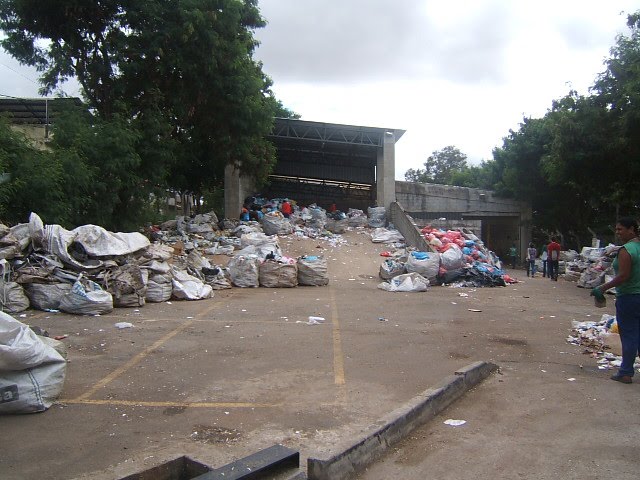
Entrance to upper silo (on left) and warehouse (on right)

Entrance to cooperative - guardhouse and scale to measure truck weight
Subscribe to:
Posts (Atom)