Saturday, July 30, 2011

Minas Gerais State Recycling Conference

A few weeks ago (yes, this is another very delayed blog post), I attended a three day conference here in Belo Horizonte sponsored by the Mineiro Solid Waste Reference Center (CMRR). Created in 2007, the mission of the CMRR is to act as the central reference point for projects, partnerships and information sharing regarding integrated solid waste management in the state of Minas Gerais. The current executive director of the CMRR is actually the founder of INSEA and has a long history of working with organizations of catadores all across the state. The full title of the conference (loosely translated) was "Toward a Minas with Recycling and Socio-productive Inclusion of Catadores."

The Conference

Attendance at the conference was about 400 people, mostly leaders of organizations of catadores from across the state and municipal government representatives. There were also representatives from various NGOs and businesses. The three days included panel discussions, debates, and focus groups. Also, outside of the conference space under a large tent, the CMRR set up demonstrations of recycling equipment used by organizations of catadores. The businesses who produce the equipment marketed their goods and interested catadores and municipal technicians could get a chance to see how the technologies work. Equipment included presses, conveyor belts (for sorting), grinders and gas-powered carts.

The ultimate goal of the conference was to brainstorm and discuss ideas regarding the implementation of recycling programs through organizations of catadores and then create a "final document" outlining as many of these suggestions as possible. During the conference, the president of the Foundation for the Environment (FEAM), an organ of the State Ministry of the Environment, presented the State Recycling Plan, which was then "approved" by the assembly through a round of applause.

Generally speaking, I tend to be a bit skeptical of big conferences and events because I feel like very rarely are meaningful ideas actually discussed and debated. It seems to me like the ideas tend to be agreed upon ahead of time between a small group of actors and that most of the conference is more of a show to give an appearance of greater democratic participation. After all, how can you really have a meaningful debate regarding specific aspects of aproposal in a group of 400 people? This conference seemed to follow a similar script. I'm not saying that I disagreed with the ideas discussed or the final products (the Final Document and the State Recycling Program, which seem to heavily overlap), and I did find some of the panel discussions and focus groups interesting and informative. But in terms of the practical effect of moving the movement forward, I didn't find the whole exercise all that useful. But, as always, I loved the theater and music performances from the catadores, which I think do an incredible job of instilling pride and excitement regarding the movement in general.

That being said, I do think it is important to have this sort of large, state-level conference to provide a launching point to expand and improve state coordination and mobilize all actors involved. In that sense, I think the practical benefit of the conference was less the specific generation of ideas and proposals, and more the general impetus it will provide as we continue to develop our programs in the future.

Public Service Provision and the Future of Government-Catador Partnerships

The biggest idea to come out of the conference was the goal of transforming the current relationship between municipal governments and organizations of catadores. Right now these programs often function as social projects, with the municipal government providing support and funding and limited income coming only through the sale of recyclables on the private market. However, right now catadores also provide a public service for the community by collecting, sorting and reinserting recyclables into the supply chain of raw materials. This public service should be the responsibility of the municipal government, but currently it is performed not by government workers but rather by catadores who are not even reimbursed for the positive externality they are creating within their communities. A new proposal presented during the conference was to create a "Recycling Grant" where municipal governments would reimburse catadores for the public service they provide. In addition, the hope is to turn organizations of catadores into public service providers that sign formal contracts with municipal governments to handle recycling services for the cities.

Basically, this process implies two fundamental transformations. First, municipal governments would finally have an explicit obligation to create recycling programs in their communities and designate sufficient resources to that end. Second, organizations of catadores would have to develop formal, business-like structures that enable them to be efficient service providers for municipal governments.

Without a doubt, this is an admirable goal and one that I believe we have to work toward. But I do have some serious reservations about the methods being proposed. In several conversations, people have admitted to me that the idea of the "Recycling Grant" really came about from brainstorming about how to guarantee more income for the catadores. I certainly support the idea of catadores being reimbursed for the public service they currently provide, but this model seems too simplistic to me. If we are really going to say that recycling is a public service that is the responsibility of the municipal government, then our goal must be to create integrated waste management systems that adequately dispose of trash and recycle as much material as possible. The idea is to increase recycling to its maximum capacity, which means creating bold new initiatives and not continuing with business as usual. A simple cash transfer from municipal governments to organizations of catadores will not achieve this goal.

If the bigger picture initiative is to obligate governments to accept responsibility for adequate integrated waste management and then contract out these services, then I believe we need to vastly increase the capabilities of the organizations of catadores. I am still learning about contracting for waste management services in general, but I have a hard time believing that it would be possible for catadores to sign contracts just for disposal of inorganic recyclable materials while everything else is left to a separate private contractor, especially given the fragile nature of source separation programs (i.e. having people separate their recyclables into separate bins) in most municipalities. I believe that to truly be effective partners of municipal governments, organizations of catadores will need to learn how to handle more material, such as collecting organic materials and recycling them through composting and/or generation of biogas. Otherwise, the catadores will continue to be marginal actors in the waste management sector occupying a small niche of managing inorganic recycling (which makes up approximately 30% of total waste generated in most urban communities).

However, the bigger issue, and one I plan to revisit often in this blog, has less to do with which materials are handled by the catadores and more to do with their organizational capacity. Throughout my time here I have been amazed time and again by the strength, resilience and pride of the catadores and by what they have been able to accomplish within such a short time frame. The ability of these associations and cooperatives to survive and develop under such difficult circumstances is truly remarkable. Yet I am often left worried if this movement as it is currently constituted has a ceiling.

It is wonderful that the organizations of catadores are staffed and managed by the catadores themselves and are focused on the independence of the movement and solidarity among its members. But at the same time, most of the catadores have little formal education or experience with administration or financial management. As a result, there is an acute lack of business expertise within the organizations that undermines their ability to grow into more formal enterprises. These are not typical start-up companies: the cooperatives and associations often have explicit goals of equality, inclusion and democracy that conflict with traditional business models that emphasize hierarchy, cost-cutting and competitive incentive structures. I strongly admire these characteristics and I think there is a lot of value in this movement, but I worry at times that this will hold back the catadores from ever developing the ability to be a formal business that can sign contracts with municipal governments and act reliably and professionally within the framework of a public-private partnership.

So while I absolutely support the goal of formal contracts for service provision, I worry that we may be putting the cart before the horse and having these organizations assume a responsibility that they are not yet prepared for. I will return to the topic of organizational capacity and business models in future posts about the CATAUNIDOS network.


Pictures


Luciano (INSEA President) presenting during a panel discussion


Music performance by MNCR representatives


Our CATAUNIDOS exhibit outside the conference hall


Demonstration of conveyor belt for sorting recyclables

Friday, July 29, 2011

CATAFORTE Training Program in Southern Minas

So first off, my apologies for taking such a long break from updating this blog. I had been meaning to update for a while, but it got a bit lost in the shuffle as I became busier with work and everything I was learning. I'm going to try and start updating on a weekly basis now, and use this as a way for me to reflect on my experience here. I'm going to make a few quick posts in a row to try and catch up on some of the most important events/lessons I have experienced over the last two months.


A few weeks ago, I accompanied Guilherme (an INSEA technician) and Gilberto (a leader of the Cataunidos network of cooperatives here in BH) on a trip to Southern Minas, to a town called Três Corações. We spent the weekend here wrapping up a training program sponsored by INSEA called "CATAFORTE - Strengthening of Associativity and Cooperativeness among Recycling Collectors." Sponsored by the Bank of Brazil, CATAFORTE is a six-month program designed to build a foundation among catadores so that they can build or strengthen cooperatives and eventually integrate into the National Movement of Catadores.


CATAFORTE consists of 6 modules, each taking place over one weekend each month. The modules are as follows:


Module 1: Initial participatory diagnostics - Identity of the catador;challenges and opportunities; history of the profession, including organization and creation of the MNCR.

Module 2: Diagnostic of the principal challenges facing organizations of catadores; Recycling within the context of urban development, environmentalism and sustainability.

Module 3: Recycling technology and logistics; Public policies regarding solid waste management; The supply chain of recyclable materials.

Module 4: Management and logistics of productive enterprises; Formalizing productive enterprises; Strategic planning and democratic decision-making.

Module 5: The concept of the "solidarity economy"; Building networks to commercialize goods; Democracy, power and society.

Module 6: The history of social movements in Brazil; Development and social transformation; Public policies and local power; Final evaluation.


Since I only got to sit in on the final weekend class (Module 6, with a little bit of catching up from Module 5), I can't really comment fully on the entire process. That being said, I did leave the weekend with plenty of impressions.


The first thing that really struck me was just how difficult the training process is. While CATAFORTE comes with a detailed curriculum and lesson plans (prepared by INSEA's pedagogical coordinator, Aline), it is hard to make instruction completely effective in practice given the precarious situation of many of the participants. A good number of them are illiterate, have no formal education, or even suffer from learning disabilities. It is really difficult to build an effective training course when your students do not have a strong base to use for their learning. At times, it seemed hard to tell what was really sinking in, and the disparities between the students were striking (as is the case in many classroom settings). Looking over the lesson plans in detail and comparing them with my practical observations, it was pretty clear to me that most of the students did not "master" the material.


However, I don't think that is necessarily even the goal of CATFORTE. The principal effect seemed to me to be bringing all of the catadores together to discuss building cooperatives and associations and getting them used to working together and thinking about their profession in the context of the big picture. CATAFORTE is simply the first step in a long, difficult process of building a cooperative spirit and skill development to enable these organizations to grow and thrive. By itself, the course does not count for much, and will not change these people's lives in a significant way. But it does get them to think a bit, helps them to network with their peers, and builds the pride and self-confidence (especially through our presentation of graduation certificates) that will help the catadores to take the next step. Everything seems to depend on the follow-up.


Yet, the follow-up is much easier said than done. I haven't looked into this issue in detail, but it seems to me that the expansion of the CATAFORTE program has not yet been matched by the expansion of detailed organizational strategies where INSEA and its partners send technicians to these municipalities to work with the newly-trained catadores and their municipal government partners to begin the long and grueling work of building a functioning cooperative. The danger, obviously, is that CATAFORTE creates a big expectation among the catadores and then the follow-up is delayed for so long that it leaves a huge sense of disappointment and ultimately results in a wasted effort. But again, this is just my initial impression. One issue that INSEA seems to face is a lack of funds to contract capable technicians to accompany these cooperatives and associations over the long term to guarantee that they move past the initial stages of organizing and planning into actually executing the projects. (Much more on this later.)


One aspect of CATAFORTE that I really appreciated was that it was not just taught by INSEA technicians. In fact, the training team consisted of one technician (Guilherme) and two catadores who were active leaders in the MNCR - Gilberto and Luenia (a local leader from Southern Minas). Having Gilberto and Luenia there really made the course more accessible I think, and they were able to show by example just how far catadores are able to come through this movement if they stick with it. Guilherme did a great job leading the course, but as he himself admitted, Gilberto and Luenia are the ones who are really able to drive the messages home because they can relate on a much more personal level to the students. I have found that this is not only the case during our training programs. In general when working with the catadores it is so essential for us to have MNCR leaders working with us who can help facilitate dialogue and build trust and cooperation.


On a more personal note, this experience was absolutely great for me. It wasn't only about seeing how the CATAFORTE program works in practice. It was a great opportunity for me to have more direct, personal interactions with the catadores. Going into the weekend, I was a bit nervous because I wasn't sure how they would look at me. I feared that I wouldn't be useful at all and that the whole time would just feel really awkward. I couldn't have been more wrong. The catadores were fascinated to see a gringo there, and the fact that I was coming all the way from the US to study their movement really helped make them feel more proud of what they could accomplish. They loved talking with me, and I was able to interact with them much more easily than I expected, although I did have some difficulty understanding their accents. I also helped lead some of the focus groups, and it was really the first time here that I began to feel that I really can play a productive role and that the gap between me and the catadores isn't as wide as I can imagine.


There were plenty of lighthearted moments as well. One day some of the catadores pulled a prank on me - they sent me out into the town to look for a "glass-cutting hammer" that they said they needed for some reason. I was a bit confused as to what this meant (I figured I was just translating the words wrong) or why they would need this tool, but I just decided to go with it. After getting a bunch of blank looks from various shopkeepers, I returned to the center empty-handed. The entire room burst out laughing. Of course, there is no such thing as a glass-cutting hammer and they all just thought it would be funny to send the gringo out on a wild goose chase around town looking for one. It became a constant joke for the rest of the weekend, and definitely helped me get closer with everyone. We also went out on Saturday night to a local bar where we played pool, drank, and danced to sertaneja (Brazilian country music). I can't say I'm much of a natural, but everyone got a kick out of taking turns trying to teach me.


Some pictures from the weekend:


Group discussion with MNCR flag in the middle

Guilherme giving a speech on the "solidarity economy"

Our MNCR representatives: Luenia and Gilberto

(Note: Luenia's pink shirt was from a conference of female MNCR leaders in Curitiba)

Focus group discussion: MNCR in context of social movements in Brazil

Group with certificates after graduation

Saturday, May 7, 2011

Visit to Coopersoli

Last week I visited Coopersoli, a recycling cooperative in BH. I went with a few other production engineers from UFMG. We are conducting various visits to cooperatives and associations in the area to develop two projects: improve the production process within the warehouses (flow of materials) and the commercialization of the products themselves. Over their years of working with various organizations, Dr. Lima and his students have developed a set of best practices to make warehouse operations more efficient. We will be examining current structures and working to put those practices into effect. Commercialization will deal more with researching the raw material supply chain, figuring out how to add value to products, and doing cost benefit analysis regarding collection, sorting and processing of various materials.

All recycler organizations have their own operational structure, but the basic process normally works as follows:

1. Trucks arrive carrying material, truck is weighed and unloaded (usually by men)
2. Sorters (usually women) sort through the material, the most complex and time consuming process
3. Material is weighed and stored
4. Material is then compressed, packaged and stored again
5. Material is loaded on to truck for delivery

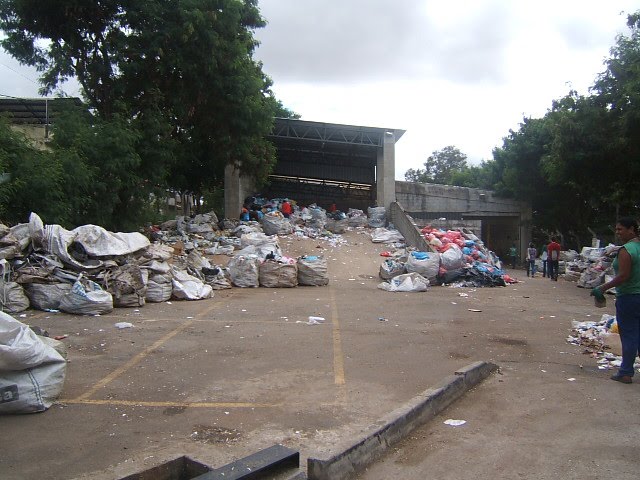
The Coopersoli warehouse was a bit of a mess, and Cinthia (one of the students I work with) told me that she thought the set-up was especially bad. Because of all the various materials coming from different origins and the complex process of sorting, these warehouses always look a bit chaotic. One of the problems with the Coopersoli warehouse, for example, is that there is only one entrance, meaning that the material enters to be sorted and exits to be delivered through the same door, creating lots of confusion. Also, the truck dumps some materials into a silo at another side of the warehouse, where a huge amount of material clogs up, sometimes to the point where the truck cannot even enter into the area again. Here are some pictures:


Sorting Tables


Sorting in the upper part of the silo


Sorting at the counter under the silo


Entrance to upper silo (on left) and warehouse (on right)


Entrance to cooperative - guardhouse and scale to measure truck weight


Sunday, April 10, 2011

Some Pictures of BH


A view of a neighborhood on the north side of the city in the mountains


As I mentioned before - the tree-lined streets and creatively paved sidewalks are two of my favorite parts about the city


Liberty Palace - former headquarters of the Minas state government and probably the most iconic building in BH


Former headquarters of the State Ministry of Culture
(All the old buildings in the city center have been turned into museums as the state government facilities have been moved outside of the city to a futuristic "Adminstrative City")


View of BH from Mangabeiras Park, in the mountains about the city

Friday, April 8, 2011

CATAUNIDOS Seminar

This week was absolutely incredible. I spent two days at a seminar here in BH hosted by INSEA. The purpose of the conference was to discuss the strengthening and expansion of the CATAUNIDOS network. CATAUNIDOS - a combination of "catador" (scavenger) and "unidos" (together) - is the name for the BH municipal area network of recycler organizations. Currently, there are 9 participating cooperatives and associations. 14 other groups were invited to the conference to discuss joining the network. In addition to inviting representatives from these 23 organizations, we also invited representatives from the municipal governments - key partners in any attempt to build/strengthen wastepicker organizations in local communities. The overall attendance at the event was roughly 150 catadores and 50 technicians/municipal government representatives.

The first day consisted of panel discussions to discuss challenges and opportunities for building networks of catadores and integrating them into structures of solid waste management across the country.

The first person to present was a representative from the federal government, which has an inter-ministerial committee formed by the Ministry of the Environment and Ministry of Social Development that focuses specifically on supporting catadores. In the last 10 years, thanks to efforts by the National Movement of Catadores (MNCR), the PT-led government has adopted numerous laws and decrees meant to provide support to the cause. This committee is leading the way - but obviously putting words into action, getting local partners to sign on and finding funding have not been easy.

The second representative was from the Entrepreneurial Pledge for Recycling (CEMPRE), an association of businesses working to promote recycling among the business community and guarantee the insertion of organizations of catadores into the industry supply chain. CEMPRE provides logistical support for the economic aspect of these endeavors and helps to increase the supply of separated, recycled materials.

The other representatives on the various panels included the director of recycling programs for the solid waste management agency of the state government of Minas Gerais, a leading representative of the MNCR, a director of CATAUNIDOS, representatives from the Bank of Brazil and Petrobras (two key financiers of these endeavors), a rep from INSEA, and two representatives from CATASAMPA, a large and successful network of catadores in Sao Paulo.

The second day, participants broke down into group discussions, with catadores and municipal government representatives separating to discuss various challenges and potential actions that could be taken in regards to strengthening the CATAUNIDOS network. The seminar closed with the director of INSEA talking about future steps beginning at the end of this month to begin executing the previously devised action plan that would involve working in each of the municipal areas with participating groups. Basically, the practical effect of the seminar was to build camaraderie and a mutual vision of the challenges/opportunities available while also preparing all actors involved for the undertaking that will formally begin at the end of this month.

Obviously it was exciting for me to learn so much about these initiatives from so many different perspectives and get insight into various logistical issues covering a wide range of topics: 1. Public policy and political support 2. Business management issues and economic models 3. Technical issues of waste management, collection processes and available technology/equipment, and 4. Social mobilization both among catadores and with the community at large.

But honestly, I was more excited just about the general atmosphere I witnessed. It honestly felt like I was at a giant two-day party. Things weren't always happy - at some point when people talked about the difficulties they were facing and the threat of their organizations collapsing I was on the verge of tears. But overall, the environment was incredibly uplifting.

Between panel discussions, there was a theater group from the MNCR that led everyone in songs, dances, and even brief skits. Everyone was dancing and singing. The lyrics of the songs were beautiful - talking about the difficulties of life in the landfill but pride in the work and the cause and the love of recycling. The skits were even more impressive. In what was probably my favorite part of the entire event, the theater group put on a brief skit where one of them dressed up as a snobby mayor obsessed with reelection and another dressed up as an arrogant foreigner (yes...American) trying to convince the mayor to give him a contract to build a giant incineration plant to burn all the trash and get all the people out of the dumps and landfills. (Yes, this is a daily struggle catadores deal with - fighting powerful businessmen trying to sell the latest waste management technology that almost always is shockingly environmentally irresponsible and also completely marginalizes the catadores as important political actors with a stake in the system.) For the skit, the theater group allowed various catadores to take turns jumping in to the scene in order to convince the mayor instead to support them in building a joint waste management/recycling program that would be more environmentally friendly and provide better economic opportunities for the poorest community members.

The skit was absolutely hilarious, the actors were great and the entire room was laughing nonstop. But even more impressive to me were the catadores themselves. Although I knew that there was strong leadership within the MNCR, I have to admit I was a bit skeptical as to how involved the average catador actually is - I imagined a few charismatic people surrounded by a group of strong, passionate government officials and NGO workers that really kept the movement alive. Man, was I wrong. I was amazed by how intelligent, articulate, passionate and proud they all were. Time and time again, whether it was taking the stage for a skit or song, leading a panel discussion or contributing an idea in group sessions, so many different catadores stood up to speak their mind and blew me away. This is truly what a grassroots movement is all about - a group of people who believe in their cause, who support each other as a tight knit community, who are willing to fight the power structures that continue to oppress them and who are willing to laugh and have fun along the way. I was so moved by what I saw that words can barely describe it.

Obviously, there are huge challenges we are facing moving forward on a variety of fronts. But after this week, I'm ready to dive in 100%. This is truly one of the most amazing movements I have ever witnessed and I am so honored to have this opportunity to participate during my time here in Brazil. I can't wait to report back with my next update.

Probably the most frustrating thing for me about the seminar is that both days I forgot to bring my camera. I really would have loved to share pictures and maybe even some video with all of you. Represenatives from INSEA were taking a lot of pictures so hopefully I will be able to get my hands on some of those and post them. Regardless, I am going to another seminar next week in the North of Minas Gerais (a notoriously poor area of the state) and I will be sure to bring my camera then. So check back soon!

Sunday, March 27, 2011

INSEA

So I’ve officially been here in Brazil for a month now. Pretty unreal how quickly time is going by. I still feel like I’m in the process of settling in: just starting now with classes, moving into my apartment, getting my research started, making friends.

At this point I should probably put up some pictures, but the embarrassing truth is I have yet to take a single photo. I’ll try and take care of that this week and put up another post soon.

On Friday I visited the Nenuca Institute for Sustainable Development (INSEA), an NGO here that focuses on organizing wastepickers and integrated waste management systems here in Brazil. INSEA began just ten years ago as the result of a successful pilot project between Pastoral da Rua (a charity run by the Catholic Church) and the municipal government of Belo Horizonte. That project led to the creation of ASMARE – a recycler association that numbers roughly 300 strong and is now quite famous here in BH. Several people involved in that effort were so pleased with the outcome that they decided to found INSEA in order to continue the project of organizing wastepickers throughout the state of Minas Gerais. With support from the Inter-American Foundation (a US grassroots development agency where I interned several summers ago), INSEA developed programs in six municipalities around Minas. They are currently working to expand their efforts to 80 municipalities across the state, and I’ll be working with them in this effort.

What really impressed me about INSEA’s methodology was its participatory, grassroots structure. When they are beginning a project in a new area, INSEA doesn’t just rush in and try to impose its system on the local communities. Instead, they start by organizing local teams to take control of the projects. Then, INSEA experts work with these teams to carry out two preliminary diagnostics – a technical evaluation of the current waste management system and participatory meetings to learn about the structure and culture of wastepickers in the area. Afterwards, the local team and INSEA workers organize a large seminar with various local actors—wastepickers, government officials, businesses, residents and community leaders—to discuss the results of the diagnostics and ideas for moving forward. The goal of these seminars is to create a support network for the project and to enable the community to buy in to the project, especially in terms of coming to view wastepickers as key protagonists in waste management systems. After the seminar, INSEA and the local team develop a permanent structure of regular forums of “Waste and Citizenship” designed to create a space for long-term public discussion of the initiative and promote sustainability. Then, the local team uses these discussions to develop a plan for recycling and waste management specifically geared to local conditions and sensibilities. This includes three complimentary aspects: outreach campaigns to spread awareness in the community, social organization of waste picker groups and developing the structure and logistics of selective collection of recyclables. Regular monitoring and follow-up are a key part of ensuring the sustainability of these projects. And that’s basically the way the projects work. Of course this is a broad overview – I’ll have many more details in future posts, especially regarding the process of building effective waste picker organizations.

On Monday, I’ll be traveling with some INSEA representatives as they do some field visits to monitor projects around the metro area of Belo Horizonte. I’m so excited to finally get to see how everything works up close. I’m sure I’ll have another update to come soon.


www.insea.org.br

Sunday, March 13, 2011

Post-Carnaval Thoughts

Ok, two weeks here and I'm updating my blog for the first time. I have a feeling this may be a short lived endeavor. Anyway, not much news on my research front - everything has been on pause for Carnaval. I'm meeting with Dr. Lima tomorrow to talk about a research plan, etc. I'm also going to enroll in his class, which is about "Work Organization" - a combination of philosophy, psychology, economics, engineering. Should be very interesting, and pretty different from my US education experience.

Carnaval was an absolute blast. I had so much fun going to block parties and other events here in Belo Horizonte. Minas Gerais is famous for its small colonial towns outside the big cities, and I went with some friends from the hostel to big Carnaval parties in Nova Lima and Sapara. Nothing crazy on the scale of Rio or Salvador (or even Ouro Preto, the most famous colonial town and the center of the Minas Carnaval scene), but it was still a huge party all over the place. Got to see some Axe concerts and Samba schools, combining the two most important flavors of Carnaval.

Living at the hostel has been pretty fun actually. It's an incredibly social environment (Brazilians are crazy friendly) and I've met a lot of great people. But I'm definitely ready to move out into an apartment. My friend Thyago (an Italian who is going to live in BH for a year) is going to room with me, and we start searching tomorrow. Hopefully I'll be out of here within a week or so, but until then I'll enjoy it here.

Thoughts about the city:

Belo Horizonte is an incredibly beautiful city, especially now that the rains have finally stopped (I came right at the tail end of the wet season, it was really awful for a bit). The sidewalks are paved in artistic designs and there are trees everywhere along the roads, so many that in some points they form a canopy over the street. The weather is incredibly beautiful (70s all the time) and because the city is so steep and hilly there are incredible views all over. Nature is incredibly abundant here, and there are so many parks both in the city and in the surrounding region that you never feel trapped in a big urban environment. The architecture here is incredible - tons of old school colonial buildings pop up all over the place, fitting in neatly next to modern skyscrapers. It is easily one of the most beautiful cities I have ever seen in my life.

The culture here is also very fun. Compared to the beach cities of Rio and Salvador or the economic powerhouse of Sao Paulo, BH is very calm. The city is very chill - fun and cool, but calm. BH is famous as the "bar capital of Brazil" - walk down any block in the central area of town and you'll see a bunch of people sitting outside, drinking and talking. The city's nickname is "A Roça Grande" (the big country town) and it certainly lives up to that. So far, I've found that BH combines the best of both worlds - the natural beauty, familiarity and relaxation of country life with the diversity, sociability and dynamism of the big city. I can't wait to get outside the city a bit too and see some of the nearby attractions: waterfall parks, caverns, and more colonial towns.

Some random first impressions about Brazil:

1. I've really been struck by the strong sense of community here in general. People always talk about life in the big cities as very isolating - everyone walking by each other on the streets, oblivious to the world around them and focused on their own personal bubbles. But Brazilians here really do seem to connect with each other in a much stronger way, striking up casual conversation, cracking jokes, making connections with strangers in an effortless way. Of course, I'm sure some of that has to do with Carnaval season, and somewhat with the fact that so many people here are transplants from small country towns. And in the one robbery I witnessed from afar so far (yes, Brazil is dangerous), no one seemed to do much to help. But overall, at least so far, I've really been struck by how tangible the Brazilian community really is.

2. I read a lot about race relations in Brazil before coming here, but it has still been fascinating to witness in person. Especially after reading two books about the black community in the US and reflecting a lot about the issue of race relations, it's remarkable to come to a country long hailed as a model of racial harmony. For those of y'all who aren't very familiar with Brazil, the country is a very diverse blend of African, indigenous and European heritage, with a huge Japanese population as well. The diversity I see walking around is striking, arguably as diverse as any city in the U.S. There really aren't "races" here the way we think of them in the US. Everyone is just a different shade, some are lighter, some are darker and it's really hard to draw a clear line. In many ways, this is what the US may come to look like in the future as interracial couples continue to skyrocket.

In a lot of ways, diversity in Brazil seems a lot better. There is way more interaction between people of all colors and backgrounds, and the blatant stratification of society that was all too painfully visible to me in the U.S. doesn't exist. Part of that simply has to do with the size of the relative populations (you can't really talk about "minority groups" as easily here because there is no clear majority/minority), but there is also something fundamentally different about the way racial relations developed through the history of this country.

But at the same time, there is visible racism here. The whiter you are, the more likely you are to be well off, and the darker you are, the more likely you are to hold lower positions in the labor force. Even just by looking at ads on TV and billboards or watching men chase girls around at the Carnaval festivities, it's clear that whiter is considered "preferred" in many ways. The problem with racism in Brazil is that it is kind of a taboo topic - no one really wants to talk about it because it's so much harder to draw any sort of clear categories between groups or to discern any specific forms of overt discrimination. Being here, I wonder in many ways if this is the future of the US. Will we hit a point where race relations have improved to the point where nobody wants to talk about it, but not enough to actually solve the profound inequalities in the system? Part of me thinks that we are already headed in that direction...

3. I've also paid a lot of attention to gender relations here, partly because it's something that bothered me almost right off the bat. Just like a lot of places I've visited in Latin America, the guys tend to be really inappropriate toward women. They will shout at them, grope at them, harass them in an attempt to pick them up. Several times during Carnaval I saw guys walk up to girls and just grab them to kiss them and continue to try even when the girls were resisting. (I even went up and split two people away at one point when I saw a girl trying to pull away.) While I do believe to a certain extent in cultural differences, the sort of harassment women go through here on a regular basis really bothers me. Hanging out in groups of guys that act the same way, I've almost felt complicit in it. But at the same time, women here also can be incredibly direct. (I can't even count the number of times I got groped at Carnaval...) And in some of my personal experiences, they actually try and get you to grab at them in a sort of back and forth flirt-and-pull-away game. So to some extent, I really do believe it is a cultural difference. And in Brazil's defense, they have a female president already whereas in the US neither of our major parties has ever even nominated a female candidate. In terms of daily interactions though, I think this is something that will continue to bother me throughout my time here.

Ok, that's all I got for now. This blog post is so long! I'm gonna try and get better at this, making shorter, more interesting (note: funny) posts with pictures and all that good stuff. Until then, you'll just have to put up with my boring stream-of-consciousness rambling.